RetinaEcho: Leveraging Archival Retinal Scans for AI-Assisted Glaucoma Progression Forecasting
RetinaEcho
Project Overview
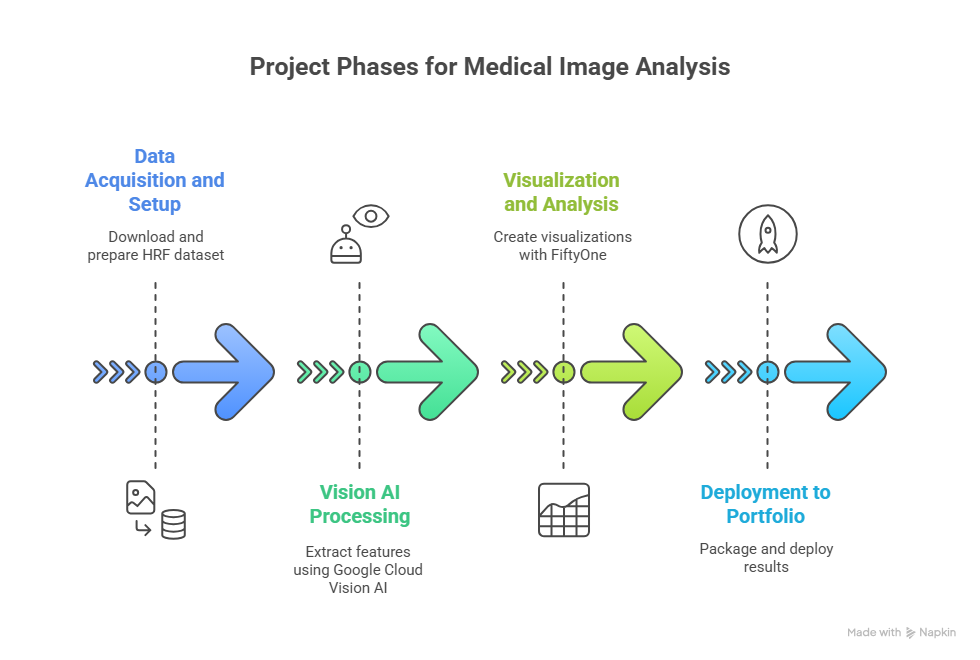
The “RetinaEcho” project utilizes the High-Resolution Fundus (HRF) dataset with Google Cloud Vision AI to develop an AI-assisted system for glaucoma diagnosis and prognosis. The project integrates advanced visualization with FiftyOne and culminates in an interactive demo for portfolio deployment. The workflow is divided into four phases, progressing from data setup to deployment, focusing on healthcare-relevant retinal and scleral feature analysis.
Project Phases
Phase 1: Data Acquisition and Setup
Objective: Download, verify, and prepare the HRF dataset for processing; establish a local environment for Google Cloud Vision AI integration.
Why: Ensures accurate image data (from all.zip) and a robust setup for medical-grade analysis.
Phase 2: Vision AI Processing and Feature Extraction
Objective: Process HRF images using Google Cloud Vision AI to extract features (e.g., color properties, labels, optic disc localizations) relevant to glaucoma diagnosis and prognosis.
Why: Provides raw data for biomarker detection, critical for healthcare insights.
Phase 3: Visualization and Analysis with FiftyOne
Objective: Import Vision AI outputs into FiftyOne for unique visualizations (e.g., retinal heatmaps, embedding clusters) to support exploratory diagnosis and prognosis.
Why: Enhances interpretability for medical researchers by highlighting patterns like scleral pallor or vascular thinning.
Phase 4: Deployment to Portfolio
Objective: Package results into an interactive demo (e.g., via Streamlit) and deploy to a portfolio page (e.g., Firebase/Cloud Run).
Why: Showcases the project’s outcomes in an accessible, user-friendly format for stakeholders.
Project phases