Medical RAG System for Veterinary Research
Efficient way to gather data for veterinary research
The Idea
The core idea is to develop a specialized, AI-powered search and summarization tool for veterinary professionals. Critical knowledge is often buried in dense, lengthy research papers, making it challenging for clinicians and researchers to find specific answers quickly. This system enables users to ask complex questions in plain English and receive concise, accurate answers sourced and synthesized from a curated library of over 1,000 scientific papers, acting as an expert research assistant that has mastered the entire knowledge base. To respect copyright laws, either abstract based research and/or open sourced articles will be used as a prototype. A small sample set will be used.
Methodology (Our Approach)
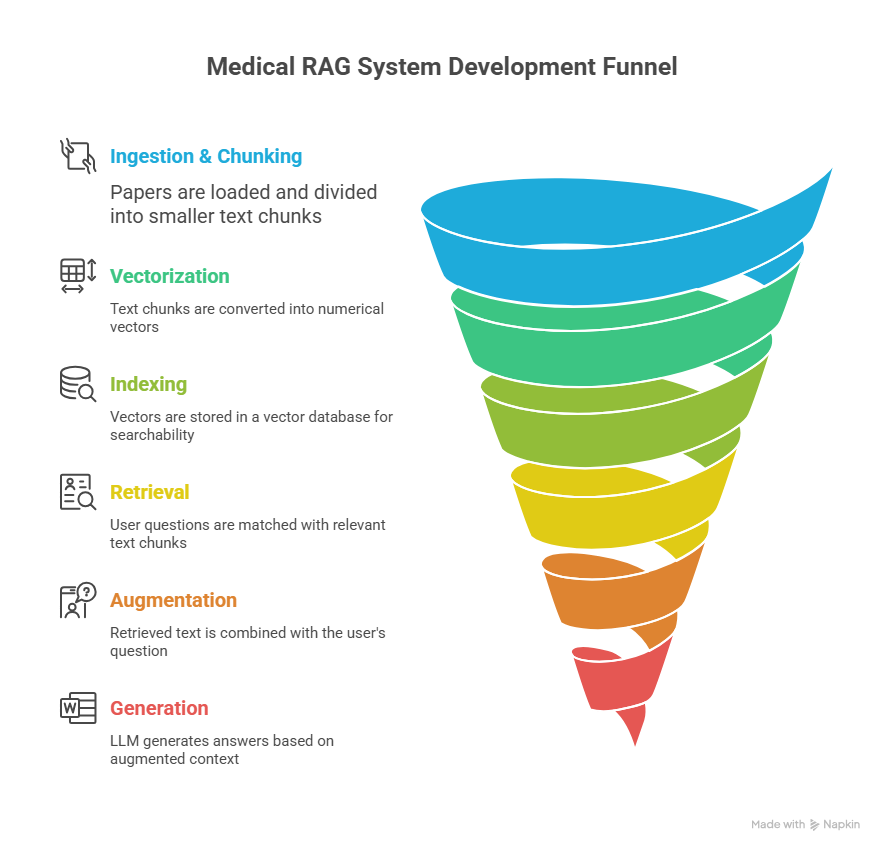
The project leverages a modern AI architecture called Retrieval-Augmented Generation (RAG), ensuring answers are grounded in source documents to minimize AI “hallucination” and inaccuracies. The pipeline consists of four key steps:
Ingestion & Chunking
- Load a large corpus of 1,000+ veterinary papers and break them into smaller, digestible text chunks.
Vectorization
- Pass each text chunk through an advanced Natural Language Processing (NLP) model (e.g., from Hugging Face) to convert it into a numerical “vector embedding” that captures semantic meaning.
Indexing
- Store vectors in a specialized vector database (e.g., ChromaDB or Qdrant) to create a searchable index of the knowledge base’s meaning.
The RAG Pipeline
When a user asks a question:
- Retrieve: Convert the question into a vector and use it to find the most relevant text chunks from the vector database.
- Augment: Combine retrieved text with the original question to form a rich prompt for a Large Language Model (LLM).
- Generate: Instruct the LLM to produce a comprehensive answer based solely on the provided context, citing sources. The process is orchestrated using a framework like LangChain.
Project Phases
Phase 1 (Prototype)
- Establish the core RAG pipeline using the initial corpus of 1,000+ papers.
- Implement a functional interface (e.g., Streamlit app) for users to ask questions and receive sourced answers.
- Goal: Prove the concept and demonstrate core functionality.
Phase 2 (Refinement & Evaluation)
- Expand the knowledge base with additional documents.
- Improve retrieval accuracy by experimenting with chunking strategies and embedding models.
- Add features to allow users to view source documents for answers.
Phase 3 (Expansion & Production)
- Scale the system to handle a larger, continuously updated corpus of research.
- Optimize database and retrieval speeds.
- Potentially fine-tune the LLM on veterinary-specific terminology to enhance answer quality.
Why & How This Project is Useful
This project is an exceptional portfolio piece that showcases in-demand skills:
Demonstrates Modern AI Expertise
- Highlights proficiency with cutting-edge technologies: LLMs, RAG architecture, vector databases, and frameworks like LangChain and Hugging Face.
Highlights Complex System Design
- Showcases the ability to architect and implement a sophisticated, multi-stage data pipeline to solve a complex information retrieval problem.
Fuses Technical and Domain Expertise
- Leverages veterinary background to curate source material and critically evaluate AI-generated answers, ensuring reliability and trustworthiness.
- Demonstrates the unique ability to build AI tools that are technically impressive and genuinely useful for a specialized professional audience.
Veterinary research flow