Establish the Regulatory Framework and Cohort Definition - using EHR
SaMD Validation Dossier
SaMD Validation Dossier for Chest X-Ray AI
Summary
This project focuses on transforming a trained chest X-ray model into a Software as a Medical Device (SaMD) candidate by producing a comprehensive validation dossier. It rigorously documents the model's intended use, clinical performance metrics, algorithmic fairness across demographic subgroups, and post-market lifecycle management plans. The resulting portfolio asset emulates a regulatory submission package, demonstrating readiness for clinical integration with electronic health record systems.
Github link
 |
Project Overview
This initial phase transforms a trained chest x-ray model into a Software as a Medical Device (SaMD) candidate by producing a comprehensive validation dossier. The objective is to rigorously document the model’s performance, safety, and fairness profile, creating a cornerstone portfolio asset that emulates a regulatory submission evidence package. This process showcases expertise in the critical “post-modeling” lifecycle, from defining clinical use to planning post-market surveillance.
Core Tasks
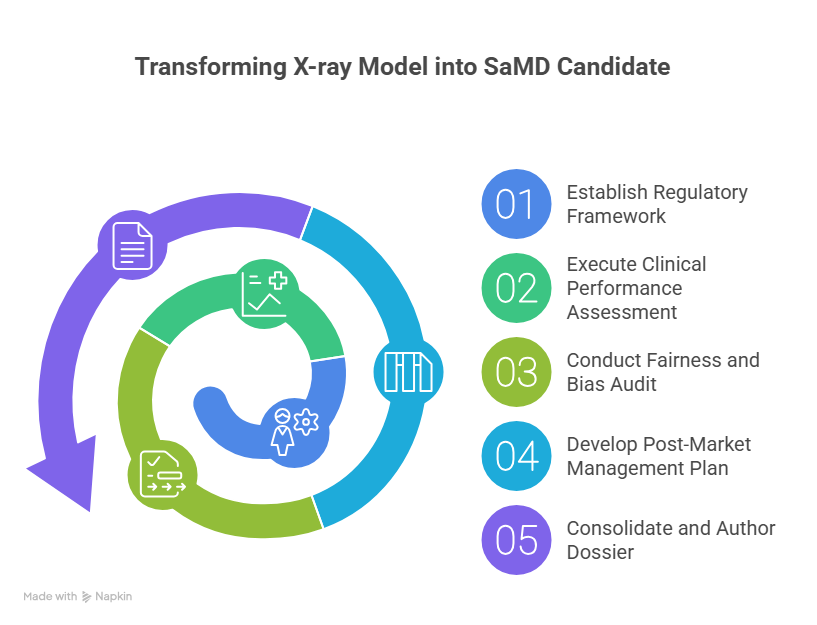
1. Establish the Regulatory Framework and Cohort Definition
- Intended Use Statement: Author a formal statement defining the model’s purpose (e.g., “to assist radiologists in the detection of cardiomegaly in adult frontal chest radiographs”).
- Indications for Use: Specify the target patient population (e.g., ambulatory patients over 18) and intended clinical workflow, detailing the human-in-the-loop role (the radiologist).
- Cohort Stratification: Implement a reproducible script outlining inclusion and exclusion criteria applied to the chest x-ray dataset to create the final validation cohort.
2. Execute a Rigorous Clinical Performance Assessment
- Run the model on a held-out test set to generate key performance metrics against the ground truth (clinical endpoint).
- Document the following metrics:
- Area Under the Curve (AUC)
- Sensitivity
- Specificity
- Positive Predictive Value (PPV)
- Negative Predictive Value (NPV)
- These results form the core clinical evidence of the model’s diagnostic efficacy, central to the dossier and akin to data for regulatory clearance.
3. Conduct an Algorithmic Fairness and Bias Audit
- Analyze model performance across demographic subgroups in the dataset’s metadata (e.g., age brackets, sex).
- Document performance disparities to assess algorithmic bias, a critical safety and ethical consideration for regulatory bodies.
- Identify and document the top three potential failure modes (e.g., poor performance on images with pacemakers, confounding signals from portable x-ray machines) and propose mitigation strategies.
4. Develop a Post-Market Lifecycle Management Plan
- Draft a plan for post-market surveillance to ensure sustained model performance post-deployment.
- Define specific triggers for model retraining, including:
- Quantitative thresholds for data drift (changes in image acquisition parameters).
- Concept drift (changes in disease presentation).
- This plan demonstrates foresight into the total product lifecycle, a key aspect of robust AI governance.
5. Consolidate and Author the Final Validation Dossier
- Synthesize all components—Intended Use, cohort definition, performance metrics, bias audit, and monitoring plan—into a polished PDF document.
- Format the dossier as a pre-submission package with an executive summary and detailed appendices.
- The output will be a compelling narrative for your cytos.dev portfolio, proving the model is accurate, safe, fair, and ready for clinical integration with an Electronic Health Record (EHR) system.
SaMD Validation